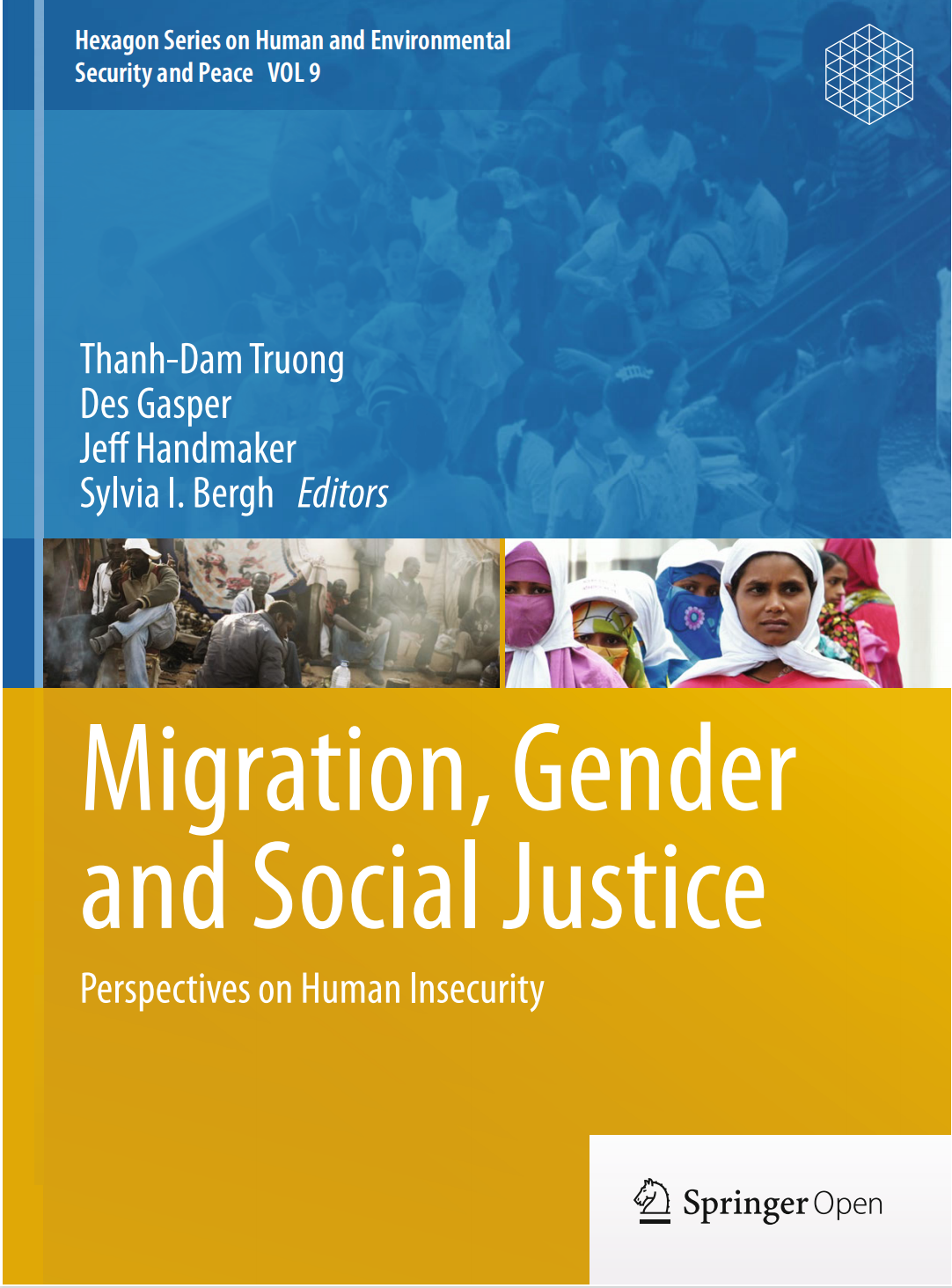
Migration, Gender and Social Justice: Perspectives on Human Insecurity
Migration, Gender and Social Justice: Perspectives on Human Insecurity is a 2014 open-access book published by Springer as part of the Hexagon Series on Human and Environmental Security and Peace (Vol. 9). Edited by Thanh-Dam Truong, Des Gasper, Jeff Handmaker, and Sylvia I. Bergh, all affiliated with the International Institute of Social Studies (ISS) at Erasmus University Rotterdam, it draws on multidisciplinary research from Africa, Asia, Europe, and Latin America. The book synthesizes findings from the International Development Research Centre’s (IDRC) Women and Migration program (2006-2011), funded under the Women’s Rights and Citizenship initiative, and the subsequent Migration, Gender and Social Justice (MGSJ) synthesis project (2011-2013). It aims to highlight Southern perspectives on migration, challenge dominant policy frames, and advocate for social justice by addressing power structures (gender, class, race/ethnicity, generation) that create inequalities in migration institutions. The focus is on human insecurity—vulnerabilities in livelihoods, rights, and dignity—while emphasizing women’s experiences, though it also explores masculinities and legal liminality. The book includes policy briefs for advocacy and is available free at SpringerLink.
Main Themes and Arguments #
The book critiques “sedentary bias” in policy and research, where migration is seen as exceptional or pathological, despite its centrality to socioeconomic change under global capitalism. It argues that migration regimes—combining nation-state borders, market forces, and gender norms—often exploit migrants, especially women, through temporary or irregular status, echoing indentured labor systems. A human security lens, enriched by gender and intersectionality, is proposed to analyze vulnerabilities and promote rights-based approaches. Key points include:
- Intersectionality and Power Dynamics: Migration outcomes depend on overlapping identities (e.g., gender with class or ethnicity) and institutional practices (legal regulations, resource flows). Women face unique burdens in social reproduction (care, family responsibilities) while navigating exploitation.
- Invisibility and Misframing: Women’s work (e.g., domestic labor, care) is often unseen or devalued, leading to exclusion from protections. Masculinities are also reshaped, sometimes reinforcing vulnerabilities.
- Liminal Legality: Many migrants exist in “grey zones” of partial rights, limiting access to education, health, and citizenship.
- Agency and Resistance: Despite insecurities, migrants show resilience through networks, strategic invisibility, and advocacy.
The editors call for “re-cognition”—reframing migration beyond binaries (e.g., economic vs. forced) to recognize interconnections and promote accountability across locations.
Structure #
The book is organized into seven parts with 21 chapters, plus a preface, acknowledgments, abbreviations, contributor biographies, and index (409 pages total). It uses case studies from diverse contexts, blending empirical data with theoretical reflections.
| Part | Title | Chapters | Key Focus |
|---|---|---|---|
| I | Introduction | 1 | Overview of themes, MGSJ project, and human security framework. |
| II | Transformation of Social Reproduction Systems and Migration: Local–Global Interactions |
2–6 | How globalization alters care and work; UAE (Indonesian domestics), Spain (Senegalese women), Thailand (Burmese workers), East Asia (transnational marriages), Netherlands (migrant male domestics). |
| III | The State and Female Internal Migration: Rights and Livelihood Security |
7–10 | State roles in internal migration; India, China, Mexico (woodcarving identities), Guatemala–Mexico border (strategic invisibility). |
| IV | Complexity of Gender: Embodiment and Intersectionality |
11–14 | Gender as embodied and intersecting; Wolof migrants, Filipina domestics’ health access, media representations in Libya, Malian beggar communities in Senegal. |
| V | Liminal Legality, Citizenship and Migrant Rights Mobilization |
15–18 | Rights in liminal spaces; Chile (NGO advocacy), Saudi/UAE (domestic workers), Thailand (migrant children’s education), with a comment on challenges. |
| VI | Migration Regimes, Gender Norms, and Public Action |
19–20 | Policy and norms; Thailand (Lao–Thai migration, masculinity/safety), Costa Rica (public attitudes toward Nicaraguans). |
| VII | Conclusion | 21 | Reflections on “women in motion” amid nation-states, markets, and gender power; calls for re-cognition and research priorities. |
Key Findings from Case Studies #
- Exploitation and Insecurity: Women migrants often transition from temporary roles (e.g., agriculture) to irregular domestic work, facing abuse, health risks, and family separation (e.g., Senegalese in Spain, Burmese in Thailand).
- Transnational Families: Marriage migration in East Asia sustains welfare models but challenges gender roles; internal migration in India/China disrupts livelihoods without adequate rights.
- Masculinities and Vulnerability: Migrant men negotiate identities amid emasculation (e.g., Dutch domestics, Wolof migrants); media during Libya’s 2011 war stereotyped Sub-Saharan men as threats.
- Rights Mobilization: NGOs in Chile face limits; liminal legality in Thailand denies education; “strategic invisibility” in Guatemala protects dignity but hinders access.
- Broader Impacts: Migration intersects with crises (e.g., Libya war) and norms (e.g., blind beggars in Senegal), highlighting generational and cultural dimensions.
Recommendations and Implications #
The book advocates shifting from nation-centric policies to human security approaches that prioritize bodily/emotional needs, global links, and gender equity. Priorities include:
- Portable social protections for circular/temporary migrants.
- Research on transforming borders, South-South flows, and climate-induced migration.
- South-South-North networks linking researchers, policymakers, and advocates.
- Policy briefs to bridge rights violations across locations and improve migration administration.
Overall, the book substantiates that migration is normal but often unjust, urging re-cognition of migrants’ contributions and vulnerabilities to foster inclusive justice. It avoids politically correct claims, grounding arguments in empirical evidence from the Global South.
#Book SharingLast modified on 2025-03-01