During a recent internship, I worked as a finance news reporter intern at a major media organization, participating in the full cycle of daily news production. This experience not only enriched my practical skills but also significantly shaped my understanding of news practice and my research trajectory. One reason I made this decision was my awareness of my limited practical experience and a relatively abstract understanding of societal realities. Through the internship, I was able to observe the inner workings of news production up close. Looking back, this “lack” was neither a flaw nor a limitation; in some ways, it could even be seen as a form of self-protection. Yet, no matter how complex or imperfect, firsthand experience of reality remains irreplaceable.
At the beginning, a photojournalist told me, “In this process, you will meet different people; you might discover directions you enjoy, or realize what you are doing is what you like.” Indeed, over time, I found both to be true, though almost always accompanied by a sense of fleeing from the familiar rhythm of life. Over the five months, I worked on a variety of topics, ranging from social and economic issues to youth employment and investigative reporting. I gradually transitioned from primarily conducting interviews to taking on more independent reporting responsibilities. In the repeated cycle of production, I repeatedly asked myself: under what structural conditions is news produced?
Daily work was highly concrete and repetitive: walking through the compound to the TV station, meeting with the photographer, preparing equipment, traveling to the site for interviews, returning to the station to import footage, eating, writing scripts, awaiting review, editing, screening, occasionally attending final approvals, and then returning home. The moments I enjoyed most were often when I stood up and said, “Screening.” In this highly procedural workflow, that moment marked a sense of completion for the stage.
What struck me most was the tightly regimented temporal structure of television news production. Evening news typically aired at 8 p.m., and the pace of interviews, editing, and reviews tended to revolve around this broadcast time. Time here was not merely a technical parameter, but a structural constraint that subtly shaped journalists’ judgments and psychological states. A single story would often be adapted into multiple versions: the traditional large-screen television version, a vertical short-video version, and a version for the station’s proprietary new media platforms. Although the core facts remained consistent, the different logics of each platform gradually influenced the production process, impacting both the experience of journalists and the presentation of content.
This was particularly evident on short-video platforms. Even though my role remained that of a traditional television journalist, with my supervisor focusing primarily on large-screen broadcasts and not explicitly on metrics like views or engagement, producing the same story in a vertical short-video format often involved adjustments in editing and audiovisual style: faster pacing, more emotionally charged background music, and other modifications suited to the platform’s attention economy. This experience reminded me of lessons from my documentary editing course, where the instructor emphasized the emotional guidance of music in moving images. I began to reflect: when news is presented in short-video form through faster cuts and amplified emotional cues, does this formal adjustment subtly reshape the expressive stance of news? More broadly, could the production logic of short videos, through affective audiovisual language, exert a sustained tension on the “objectivity” of news, even if journalists do not intentionally alter the facts themselves?
Furthermore, as this emotionally-infused approach became part of the daily workflow, it could also influence journalists’ judgments about which topics are more likely to be presented or disseminated, subtly shaping editorial choices and constraining the imagination of what counts as newsworthy. These reflections have led me to pay closer attention to how digital platforms intervene in news production through both form and affect, offering both practical insights and a foundation for further research inquiry.
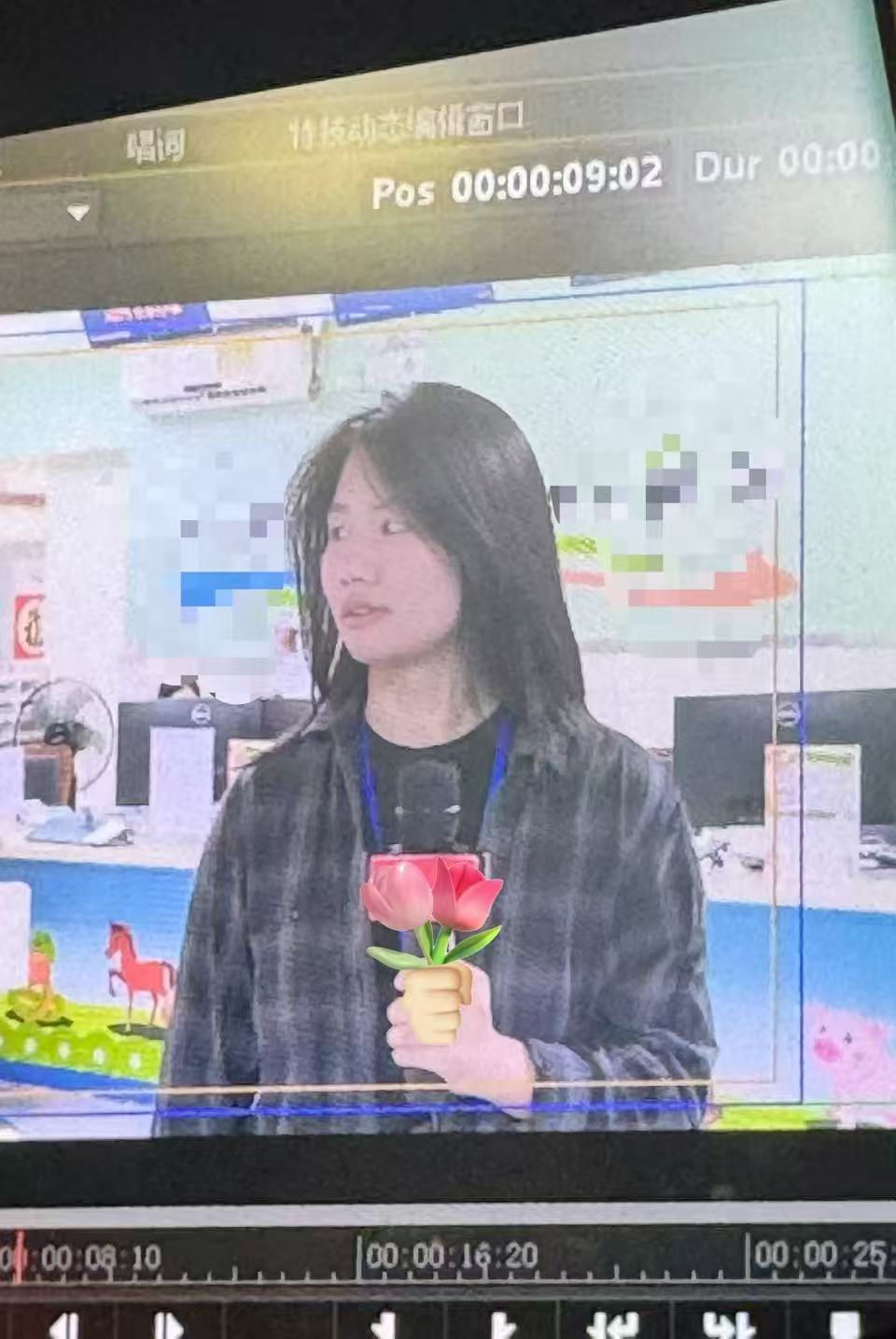
First Time on Camera as a Journalist Intern
Last modified on 2025-10-31